
How Many Solar Panels Do You Need to Power a 2BHK or 3BHK Home?
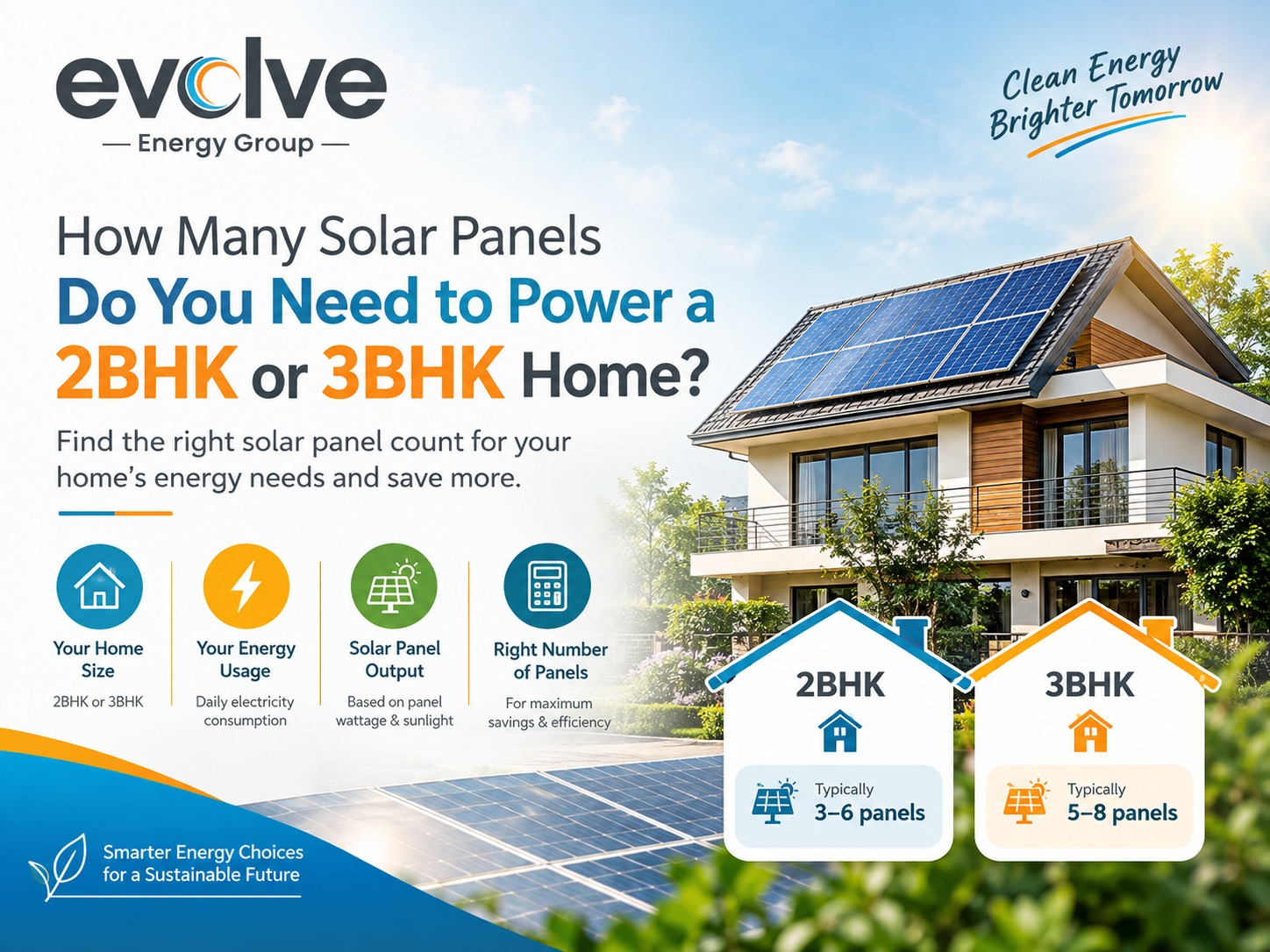
If you are planning solar panels for residential use, one of the first questions you may ask is: “How many solar panels do I need for my home?”
The answer does not depend only on whether your house is a 2BHK or 3BHK. Your monthly electricity consumption, appliances, roof space, panel wattage, sunlight, and solar system size all matter.
For example, a 2BHK home with two air conditioners can use more electricity than a 3BHK home with only fans, lights and basic appliances.
This guide explains how to estimate the number of solar panels you may need, what system size can suit a typical Indian home, and what you should check before buying a residential solar system.
How Many Solar Panels Does a Home Need?
As a simple starting point:
| Home Type | Typical Solar System Range* | Approx. Panels with 550W Panels |
| 2BHK | 2 kW–3 kW | 4–6 panels |
| 3BHK | 3 kW–5 kW | 6–10 panels |
| Large 3BHK / High Usage | 5 kW+ | 10+ panels |
These numbers are only starting estimates. Your actual requirement should come from your electricity consumption and roof conditions.
For example:
- 4 × 550W panels = 2.2 kW
- 6 × 550W panels = 3.3 kW
- 8 × 550W panels = 4.4 kW
- 10 × 550W panels = 5.5 kW
Modern residential modules can have different wattages, so the panel count can change even when the required system capacity stays the same.
What Determines the Number of Solar Panels for a Home?
Choosing solar panels for residential use should start with your energy requirement, not the number of rooms.
Here are the main factors.
1. Monthly Electricity Consumption
Look at your electricity bills from the last 6–12 months.
Your monthly units, or kWh, give you a much better idea of your solar requirement than the size of your house.
For example:
- 150–250 units/month → smaller system may work
- 250–400 units/month → medium residential system may suit you
- 400–600+ units/month → larger system may be required
These are broad planning ranges, not fixed system recommendations.
2. Appliances in Your Home
Your appliances can change your solar requirement significantly.
Consider:
- Air conditioners
- Refrigerator
- Washing machine
- Water heater/geyser
- Water pump
- Microwave
- Television
- Computers
- Fans
- Lights
- EV charger
A home that runs two ACs every evening may need a much larger system than a home without ACs.
3. Solar Panel Wattage
The wattage of each panel affects the number of panels you need.
For example, if you need approximately 3 kW:
Using 550W panels:
3,000 ÷ 550 ≈ 5.45
You would need around 6 panels, giving 3.3 kW of panel capacity.
If you use 400W panels:
3,000 ÷ 400 = 7.5
You would need around 8 panels to reach a similar capacity.
This is why you should compare the total system capacity, not just the number of panels.
How Many Solar Panels Does a 2BHK Home Need?
A typical 2BHK home may need around 2 kW to 3 kW of rooftop solar, depending on electricity use.
Example: 2BHK with Moderate Electricity Use
Suppose your home uses:
- 4 fans
- LED lights
- 1 refrigerator
- 1 TV
- Washing machine
- Water pump
- Kitchen appliances
- Occasional AC use
A 2–3 kW residential solar system could be a starting point for discussion with a solar professional.
With 550W modules:
| System Size | Approx. Number of 550W Panels |
| 2 kW | 4 panels |
| 2.5 kW | 5 panels |
| 3 kW | 6 panels |
The final design should account for your actual electricity bill, roof area, shading and local installation conditions.
How Many Solar Panels Does a 3BHK Home Need?
A 3BHK home often has more rooms and appliances, but the number of rooms alone does not decide the system size.
A 3BHK household may consider around 3 kW to 5 kW depending on its electricity consumption.
Example: 3BHK With Higher Electricity Use
Imagine a home with:
- 5–6 fans
- LED lights
- Refrigerator
- Washing machine
- Water heater
- Water pump
- 2 ACs
- TV
- Kitchen appliances
In this situation, a 4–5 kW solar system may be worth evaluating.
With 550W panels:
| Solar Capacity | Approx. 550W Panels |
| 3 kW | 6 panels |
| 4 kW | 8 panels |
| 5 kW | 10 panels |
Again, these figures help you understand the calculation. They do not replace a site-specific solar assessment.
How Do You Calculate Your Solar Panel Requirement?
You can use a simple three-step method.
Step 1: Check Your Monthly Electricity Units
Take your latest electricity bills.
Suppose your average consumption is:
360 units/month
That means your home uses around:
360 ÷ 30 = 12 units/day
Now you can estimate the solar generation needed to offset a large part of your consumption.
Step 2: Estimate Your Solar System Size
Solar generation varies with location, season, weather, panel orientation, shading and system losses.
A simple planning approach is to discuss your daily consumption with a solar installer and calculate the expected generation from a proposed system.
For example, a 3 kW system may generate different amounts in different months. You should not assume that a 3 kW system will produce exactly the same number of units every day.
Step 3: Select the Panel Wattage
Once you know the approximate system capacity, divide it by the panel wattage.
Number of panels = Required system capacity ÷ Panel wattage
For example:
3,000W ÷ 550W = 5.45
So you would normally look at 6 panels.
How Much Roof Space Do You Need?
The number of panels also affects your rooftop space.
A higher-wattage module can help you generate more power with fewer panels.
For example, if your design needs 5 kW:
- 550W panels → about 10 panels
- 450W panels → about 12 panels
- 400W panels → about 13 panels
But don’t plan rooftop space using panel dimensions alone.
Your installer also needs space for:
- Panel gaps
- Mounting structures
- Walkways
- Maintenance access
- Inverter location
- Safety clearances
- Shading avoidance
So a proper site survey matters before you buy solar panels for home.
Does a 2BHK Need Fewer Panels Than a 3BHK?
Not always.
The number of bedrooms does not directly determine solar capacity.
Consider these two homes:
Home A – 2BHK
- 2 ACs
- Electric geyser
- Washing machine
- Refrigerator
- Water pump
- Heavy daily usage
Home B – 3BHK
- No AC
- Solar water heater
- Energy-efficient appliances
- Lower daily electricity use
The 2BHK may need a larger solar system than the 3BHK.
That is why solar panels for residential use should match your electricity consumption rather than your home size alone.
What About AC Usage?
Air conditioners can increase household electricity consumption significantly.
If your home has one or more ACs, tell your solar installer:
- AC capacity
- Number of ACs
- Hours of daily use
- Summer usage
- Whether you use them mainly during the day or night
This information helps the installer design a more useful system.
If you plan to add another AC, EV charger or electric water heater soon, mention that during the solar consultation.
Should You Choose 3kW, 5kW or a Larger System?
The right size depends on your usage.
A 3kW System May Suit:
- Smaller homes
- Moderate electricity consumption
- Limited rooftop space
- Households with fewer high-power appliances
A 5kW System May Suit:
- Larger homes
- Higher electricity consumption
- Homes with multiple ACs
- Homes with several electrical appliances
- Families planning future electricity use
A Larger System May Make Sense When:
- Your monthly electricity consumption is high
- You have a large usable rooftop
- You plan to add an EV
- You operate multiple ACs
- You want greater electricity bill offset
Do not select a larger system only because you have a bigger roof. Compare your electricity use, budget and expected solar generation first.
On-Grid, Off-Grid or Hybrid: Which One Should You Consider?
Panel count is only one part of a residential solar system.
On-Grid Solar
An on-grid system connects with the electricity grid.
It can work well for homeowners who want to reduce their electricity bills and do not need battery backup for every power cut.
Off-Grid Solar
An off-grid system works without a regular grid connection and needs battery storage.
It can suit locations where grid power is limited or unavailable.
Hybrid Solar
A hybrid system combines solar, grid power and battery storage.
It can be useful when backup power is an important requirement.
Your system design should match your electricity use, grid reliability, backup needs and budget.
Do More Solar Panels Always Mean More Savings?
No.
Installing more panels does not automatically mean better financial results.
You should consider:
- Your actual electricity consumption
- Solar generation
- System price
- Roof space
- Panel efficiency
- Inverter efficiency
- Maintenance
- Electricity tariff
- Net-metering rules
- Battery requirements
- Future electricity needs
A correctly sized solar system can help you avoid spending money on capacity you may not use.
What Type of Solar Panels Should You Choose for a Home?
When buying solar panels for residential use, compare more than the price per panel.
Check:
Panel Efficiency
Higher-efficiency modules can generate more power from limited roof space.
Panel Wattage
Higher-wattage panels can reduce the number of modules required for the same system capacity.
Warranty
Check both product and performance warranty terms.
Manufacturer Support
Choose a supplier that can provide technical support and after-sales assistance.
Certification and Compliance
Ask about applicable quality standards, certifications and eligibility requirements for your planned project.
Indian Weather Performance
Your solar modules should suit local weather conditions and installation conditions.
Evolve Energy Group offers different solar module technologies, including monocrystalline, polycrystalline, PERC and TOPCon options. Its published product information also includes residential applications and high-wattage EVVO modules.
Why Are Solar Panels for Residential Use Growing in India?
Residential rooftop solar has grown strongly in India.
According to Mercom India Research, India added 6.6 GW of rooftop solar capacity during the first half of 2026, up 131% year over year. Residential installations made up 84% of rooftop additions in Q2 2026. Maharashtra ranked among the leading states for quarterly rooftop additions.
MNRE reported 32.59 GW of grid-connected rooftop solar capacity as of August 31, 2026.
This growth shows why more homeowners are researching residential solar systems, panel capacity, rooftop space and electricity savings before making a purchase.
What Should You Check Before Buying Solar Panels for Your Home?
Use this simple checklist:
- Check your last 6–12 electricity bills.
- Calculate your average monthly units.
- List all high-power appliances.
- Check your usable rooftop area.
- Look for nearby trees or buildings that can create shade.
- Compare panel wattage and efficiency.
- Check product and performance warranties.
- Compare inverter options.
- Understand installation and maintenance costs.
- Ask about grid connection and net metering.
- Check applicable government support and current rules.
- Ask for an estimated monthly and annual generation.
- Compare the complete system cost instead of only the panel price.
- Choose an experienced solar partner.
Why Choose Evolve Energy Group for Residential Solar?
Evolve Energy Group provides residential solar solutions along with solar modules, inverters, installation and maintenance support. Its residential solar page says the company has completed 500+ residential solar projects and offers customised systems based on household requirements.
The company also states that its solar business covers manufacturing, EPC, installation and O&M services, allowing homeowners to discuss several parts of their solar project with one provider.
If you are comparing solar panels for residential use, Evolve Energy Group can help you assess your electricity requirement, rooftop conditions and suitable system configuration.
Ready to understand your home’s solar requirement?
Request a residential solar consultation and get a system recommendation based on your electricity usage and rooftop.
Get a Residential Solar Quote →
Frequently Asked Questions
1. How many solar panels do I need for a 2BHK home?
A typical 2BHK may start around a 2–3 kW solar system, which could mean around 4–6 panels if you use 550W modules. Your electricity consumption should decide the final capacity.
2. How many solar panels are required for a 3BHK house?
A 3BHK may require around 3–5 kW or more, depending on electricity use. With 550W panels, that works out to roughly 6–10 panels.
3. Can 4 solar panels power a house?
Four 550W panels provide about 2.2 kW of panel capacity. Whether that can meet your needs depends on your daily electricity consumption and expected solar generation.
4. How many solar panels do I need for 5kW?
With 550W panels:
5,000 ÷ 550 = 9.09
You would generally need about 10 panels to reach or exceed 5 kW of panel capacity.
5. Does a 3BHK always need a 5kW solar system?
No. A 3BHK home with low electricity consumption may need less than 5 kW. A home with multiple ACs and other high-use appliances may need more.
6. Can solar panels run AC at home?
Yes, a suitably sized solar system can support AC use. However, the required capacity depends on the AC’s power rating, usage hours, other appliances and whether the system uses grid or battery support.
7. How do I know what size solar system my home needs?
Start with your average monthly electricity consumption, then consider appliance usage, rooftop space, shading, local solar conditions and future electricity needs. A professional site assessment can then determine the practical system size.
8. Are high-wattage solar panels better for residential use?
High-wattage panels can reduce the number of panels needed for a given system capacity. This can help when roof space is limited. However, compare efficiency, dimensions, warranty, quality and total system cost before choosing.
Conclusion
The number of solar panels for residential use should depend on your electricity consumption, not simply whether your home is a 2BHK or 3BHK.
As a starting point:
- 2BHK: around 2–3 kW
- 3BHK: around 3–5 kW
- High electricity use: 5 kW or more may need consideration
With 550W panels, this can mean approximately 4–6 panels for a 2BHK and 6–10 panels for a 3BHK.
But your final system should come from your electricity bills, rooftop survey and expected solar generation.
With residential rooftop solar expanding rapidly in India, choosing the correct system size can help you make a more practical long-term investment.

Evolve Energy