
Best Solar Panel System for Home Appliances: Capacity, Inverter and Battery Explained
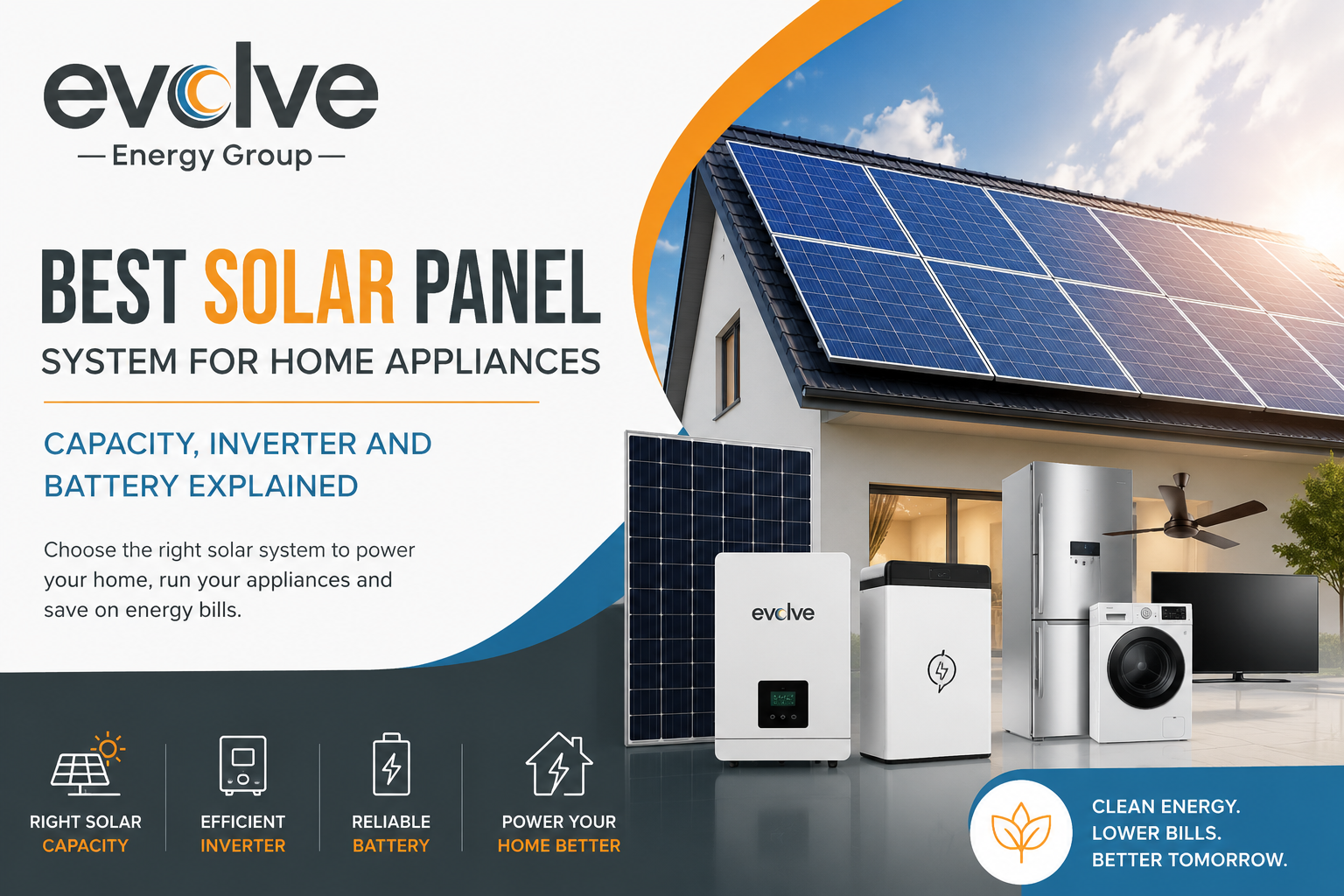
Solar power is no longer limited to lighting and a few basic appliances. With the right system design, homeowners can use solar energy for fans, refrigerators, televisions, washing machines, water pumps, computers and even air conditioners.
But choosing a solar system is not simply about buying more panels. The solar panel for home appliances must work together with the right inverter, battery, wiring and other system components.
So, what size solar system does a home actually need? Should you choose an on-grid or hybrid setup? And how do you select the right inverter and battery?
This guide explains the key factors in simple terms.
What Is the Best Solar Panel for Home Appliances?
The best solar system depends on three things:
- How much electricity your home uses
- Which appliances you want to operate
- Whether you need backup power during a grid outage
For example, a home that mainly uses lights, fans, a refrigerator and a TV may need a very different system from a house that regularly operates multiple ACs, a washing machine, water pump and other high-power appliances.
A properly designed system should match your daily electricity consumption, available rooftop area and expected future usage.
How Does Solar Power Run Household Appliances?
Solar panels generate DC electricity when sunlight reaches the solar cells. The inverter then converts this electricity into AC power that household appliances can use.
The basic flow looks like this:
Sunlight → Solar Panels → Inverter → Home Appliances
In a system with battery storage, excess energy can also be stored for later use:
Sunlight → Solar Panels → Inverter → Home + Battery Storage
The inverter therefore plays a major role in deciding how effectively your solar system works with household loads.
How Much Solar Capacity Does Your Home Need?
There is no single solar capacity that works for every home.
A useful starting point is your monthly electricity consumption.
| Monthly Electricity Use | Possible System Range* |
|---|---|
| 100–200 units | Around 1–2 kW |
| 200–400 units | Around 2–4 kW |
| 400–600 units | Around 4–6 kW |
| 600–900 units | Around 6–9 kW |
*These are general planning ranges, not final system sizes. Actual requirements depend on location, sunlight, rooftop conditions, appliance usage, panel capacity and system losses.
For a more accurate estimate, look at your electricity bills from the previous 6–12 months rather than estimating from appliance count alone.
Which Home Appliances Can Run on Solar?
A well-sized solar power system can support many common household appliances, including:
- LED lights
- Ceiling and exhaust fans
- Television
- Refrigerator
- Wi-Fi router
- Computers and laptops
- Washing machine
- Microwave oven
- Water pump
- Air conditioner
- Kitchen appliances
However, high-power appliances such as ACs, geysers, induction cooktops and pumps can significantly increase your system requirement.
If several high-load appliances operate at the same time, you need to consider both energy consumption and peak power demand.
Solar Energy Requirement for Common Appliances
The following examples can help you understand the difference between appliance types.
| Appliance | Typical Power Range | Usage Impact |
|---|---|---|
| LED bulb | 5–15 W | Low |
| Ceiling fan | 50–80 W | Low to moderate |
| Refrigerator | Varies by model | Moderate |
| Television | 50–150 W | Low to moderate |
| Washing machine | 400–1,000 W | Moderate |
| Water pump | 500–2,000+ W | High |
| Air conditioner | 1,000–2,500+ W | High |
Actual consumption varies by appliance model, efficiency, operating mode and usage time.
This is why simply adding appliance wattages does not always give the right solar requirement.
Why the Inverter Matters
Solar panels produce electricity in DC form, while most household appliances use AC power. The inverter handles this conversion.
When selecting an inverter, consider:
1. Inverter Capacity
The inverter should support the expected household load. If your home has several high-power appliances, selecting an undersized inverter can limit what you can operate at the same time.
2. Appliance Starting Loads
Some appliances need extra power when they start. Motors and compressors, for example, can create a temporary increase in demand.
3. Solar Input Capacity
The inverter should be compatible with the planned solar panel capacity and configuration.
4. Monitoring Features
Modern solar inverters may provide information about generation, consumption and system performance. This can make it easier to understand how your solar system is performing.
Evolve Energy Group manufactures solar inverters alongside solar modules and BOS components as part of its solar manufacturing offering.
Do You Need a Solar Battery?
Not every home needs a battery.
Your choice depends mainly on how you want to use solar power.
On-Grid Solar System
An on-grid system works with the electricity grid. Solar energy can power your home during the day, while the grid can support your requirements when solar generation is insufficient.
This type of system can be suitable for homeowners who primarily want to reduce electricity costs and do not require battery backup.
Hybrid Solar System
A hybrid system combines solar generation with battery storage and grid connectivity.
It can store excess solar energy and make that energy available later, depending on the system configuration and battery capacity.
This can be useful for homes that want greater energy flexibility and backup capability.
How Big Should the Battery Be?
Battery sizing depends on how much backup energy you want and which appliances you want to operate during that period.
For example, someone who only wants backup for lights, fans and Wi-Fi will have a much smaller requirement than someone who wants to operate an AC, refrigerator, pump and other high-power appliances.
A simple planning approach is:
Required battery energy = Backup load × Backup duration
For example, if selected appliances together require 1 kW and you want to run them for around 3 hours, the theoretical energy requirement is about 3 kWh. In practice, battery selection also needs to account for usable capacity, efficiency and operating limits.
How Many Solar Panels Do You Need?
The number of panels depends on the capacity of each individual module.
For example:
Total solar capacity ÷ Panel capacity = Approximate number of panels
If you install 550 W panels and want a 5.5 kW solar array:
5,500 W ÷ 550 W = 10 panels
The final design may change based on available roof space, panel layout, shading, orientation and electrical design.
A reliable solar panel manufacturer can help you select suitable modules based on the project’s power requirement and installation conditions.
What Should You Check Before Buying a Solar System?
Before investing in a solar system for home appliances, check these factors:
Your Electricity Consumption
Review your previous electricity bills to understand your actual energy requirement.
Your Appliance Load
List appliances that you expect to operate regularly, especially high-power equipment.
Rooftop Space
Check whether your roof has enough usable space for the required number of panels.
Shading
Trees, nearby buildings and other structures can affect solar generation.
Inverter Compatibility
Make sure the inverter matches the solar array and household load.
Battery Requirement
Decide whether you need backup power and which appliances must continue working during an outage.
Future Expansion
If you expect your electricity consumption to increase, discuss future expansion while designing the system.
Why Choose a Reliable Solar Panel Manufacturer?
The quality of the solar modules and other components can influence the long-term performance of your solar installation.
A reliable manufacturer should provide clear product specifications, quality information and technical support.
Evolve Energy Group offers monocrystalline, polycrystalline and Mono PERC solar modules, along with solar inverters and BOS components. Its manufacturing offering covers residential, commercial, industrial and agricultural applications.
For homeowners, working with a company that can support multiple parts of the solar system can also simplify product selection and project coordination.
Frequently Asked Questions
What is the best solar panel system for home appliances?
The right system depends on your electricity consumption, appliance load, rooftop space and backup requirements. A professional assessment can help determine the suitable panel, inverter and battery capacity.
Can solar panels run an AC at home?
Yes, a properly designed solar system can support an AC. Because air conditioners have relatively high power requirements, the solar capacity and inverter must be sized accordingly.
Is a battery necessary for home solar?
No. An on-grid system can operate without battery storage. A battery becomes useful when you want stored solar energy or backup power.
How do I calculate solar capacity for my home?
Start with your electricity bills and monthly consumption. Then consider appliance usage, peak load, sunlight availability, rooftop space and system losses.
How many solar panels are required for a 5 kW system?
The number depends on the wattage of the selected panels. For example, using 550 W panels would require approximately 10 panels to reach 5.5 kW of total panel capacity.
Which is better for home appliances: on-grid or hybrid solar?
An on-grid system can be suitable when your main goal is reducing grid electricity use. A hybrid system may be preferable when battery storage and backup capability are important.
Conclusion
Choosing the right solar panel for home appliances requires more than calculating the number of panels.
You need to consider your electricity consumption, appliance load, inverter capacity, battery requirements, rooftop conditions and future energy needs. A correctly designed system can help you make better use of solar energy while avoiding unnecessary system capacity.
If you are planning residential solar, choose products from a dependable solar panel manufacturer and get the system designed around your actual household requirements.
Planning a solar system for your home? Connect with Evolve Energy Group for guidance on solar modules, inverters and complete solar solutions.

Evolve Energy